
Battle of Molino del Rey (1847): 28mm Mexican-American War

Philip umpired another enjoyable Mexican-American War game at the Centre on 10 October. Patrick and I were the attacking Americans, with three infantry brigades (12 units) and one cavalry unit as well as four guns. Paul, Jonathan and Phil were the defending Mexicans, with 9 infantry units, three cavalry units, and three guns.
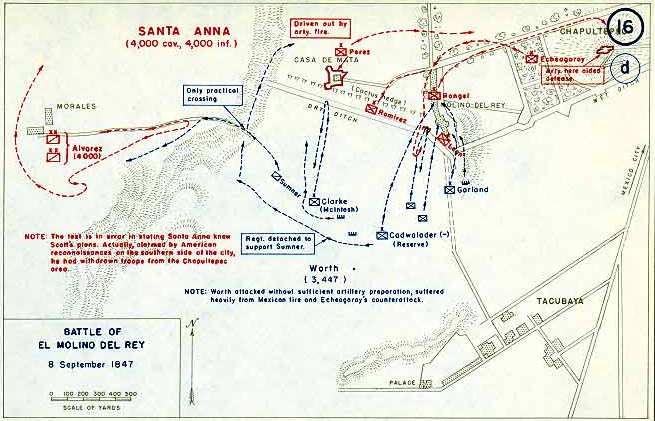
The Battle of Molino del Rey (8 September 1847) was one of the bloodiest engagements of the Mexican-American War, and part of the Battle of Mexico City. It was fought between Mexican forces under General Antonio Leon against an American force under Major General Winfield Scott. The Americans made little progress in this battle, but the Mexican forces were unable to hold them back long enough to prevent the capture of Mexico City one week later.

The Mexicans occupied two walled urban areas, with two redoubts between them. A formidable position! The Americans did not have a marked numerical advantage.

The Americans deployed with two infantry brigades under Patrick on the right, and a further infantry brigade and the cavalry on the left under my command. We each trained two guns on the Mexican positions, two of which were deployed on the hill in the centre of our line.

Patrick began the attack on the right with 8 infantry units in two brigades, focusing on Phil’s enclosure on the Mexican left. His artillery deployed on the hill, and on the right close by.

I moved the US cavalry forward onto the hill on our left, supported by its artillery. I paused with my 4 infantry units, but deployed their artillery on the hill.

The rules, Once in a Maximilian, use d6 dice marked red or black for activations. These proved simple to grasp, but far from tactically reliable! Once in a Maximilian, indeed…

The American guns were rifled so had better range and ‘elite’ status, but were blighted by having to fire on the closest target, and the frequency of ‘black’ being rolled on the d6s – often negating their effectiveness.

Patrick’s two brigades went in, and a couple of units began to assault the Mexicans in the walled area.

However, one US unit was thrown back by the nearest Mexican battery in the centre.

Various American units assaulted the walls, but two had to retreat owing to failed morale tests caused by Mexican artillery and infantry fire.

Eventually, Patrick destroyed a Mexican battalion and gained a foothold inside.

He advanced further and another Mexican battalion was destroyed.

Meanwhile on my flank, I rapidly responded to the numerically superior arriving Mexican cavalry with my own advance. The aim was to confine the Mexicans to their flank, to prevent a threat to my line.

A series of melees however led to the US horsemen being pushed back, the loss of their general, and eventual destruction by the Mexican cavalry.

Before that, I directed my infantry brigade, which had been waiting in the centre, to attack the other enclosure.

My infantry was halfway there, before I diverted one unit to assault the Mexican battalion which had emerged into the open from behind one of the central redoubts. This melee was a US success, and the Mexicans were repulsed. Soon enough however I faced Mexican canister and my victorious unit was wiped out!

I charged the wall with another unit, but was destroyed by withering infantry and artillery fire (which our guns had not been able to suppress or prevent). The attack was clearly futile, and I disengaged my remaining two battalions.

The game ended with a minor Mexican victory. They had lost 2 units, to the American 3…

Overall an enjoyable night with some brilliant figures and friendly banter, well hosted by Philip. The rules seemed playable and straightforward, if frustrating at times owing to poor activation rolls and the impermissibility of choosing artillery targets at will. Nonetheless, a neat period with a lot of wargaming potential!


