
Wargaming the French Revolutionary Wars (1792-1802)

I have been collecting and painting 28mm French and Austrian figures for wargaming the French Revolutionary Wars (1792-1802) during the past year or so. It is a fascinating period with much wargaming potential which is relatively unknown compared to the Napoleonic Wars and so well worth exploring and gaming. This blog showcases some of my figures and gets to grips with this evocative period, focusing on land warfare, and including brief historical background, tactics, figures, rules and suggestions for further reading.
Introduction
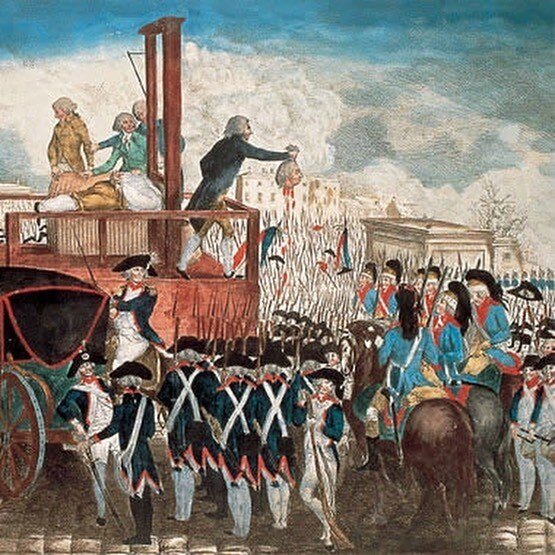
Execution of King Louis XVI (21 January 1793)
The French Revolutionary Wars were a series of major military conflicts that spanned from 1792 to 1802. They emerged directly from the French Revolution, pitting the newly formed French Republic against various European monarchies, including Great Britain, Austria, Prussia, and Russia. The turmoil of the Revolution, with its radical political and social changes, created deep anxieties among neighbouring European monarchs who feared the spread of revolutionary ideals. The Declaration of Pillnitz (1791) by Austria and Prussia, while intended to be a warning, was interpreted by the French as a threat of intervention. This, along with internal pro-war factions like the Girondins, pushed France towards conflict.
I. HISTORICAL BACKGROUND
The Revolutionary Wars period spans 10 years and hundreds of engagements (see Bibliography). The wars are generally divided into two main periods however:
1. War of the First Coalition (1792–1797)
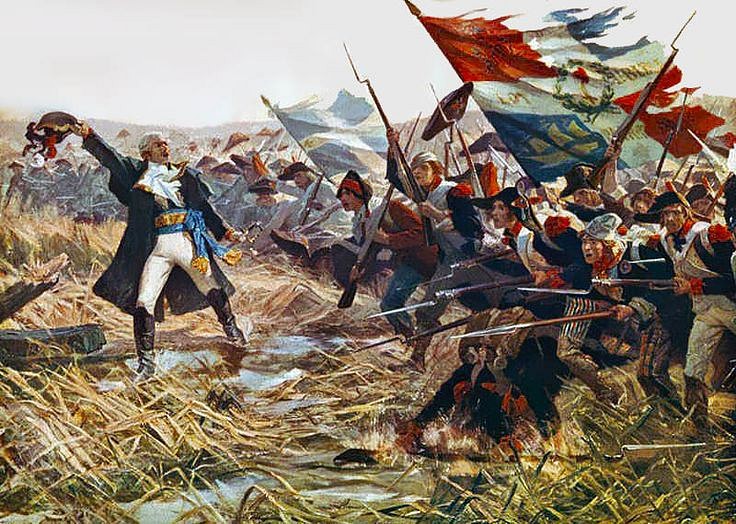
Battle of Jemappes (6 November 1792)
Initially, a coalition of powers including Austria, Prussia, Spain, Britain, Portugal, and Naples sought to suppress the French Revolution and restore the monarchy. France declared war on Austria and Prussia in 1792. France, initially disorganized, suffered setbacks followed by the declaration of a Republic and mass conscription (levée en masse). This allowed France to field much larger armies than its opponents. Eventually France pushed back the invaders. French victories, such as those at Valmy and Jemappes, secured the Belgian provinces for France. Napoleon Bonaparte began his rise during this period, notably through his successful leadership during the Siege of Toulon in 1793. Within a few years Napoleon had achieved a series of decisive victories in his Italian campaigns, forcing Austria to sign the Treaty of Campo Formio in 1797, effectively ending the First Coalition. This treaty resulted in significant territorial gains for France. The First Coalition thus ultimately ended in a French victory.
Battle of Valmy (20 September 1792)

A crucial victory where French forces stopped a Prussian advance on Paris, bolstering the new Republic.
Siege of Toulon (29 August-19 December 1793)
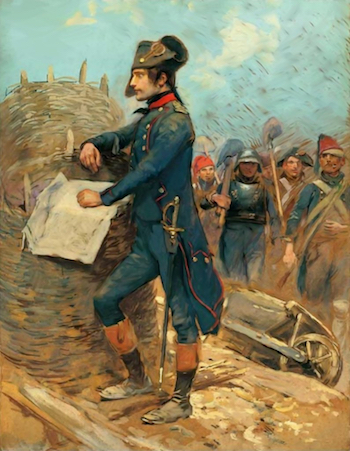
A strategic British naval base was captured by French forces, a key moment where Napoleon distinguished himself directing the artillery.
Battle of Fleurus (26 June 1794)

A decisive French victory in the Austrian Netherlands by General Jourdan that secured the Republic’s borders and marked a turning point for the French army, which remained ascendant for the rest of the War of the First Coalition.
Battle of Arcola (15-17 November 1796)
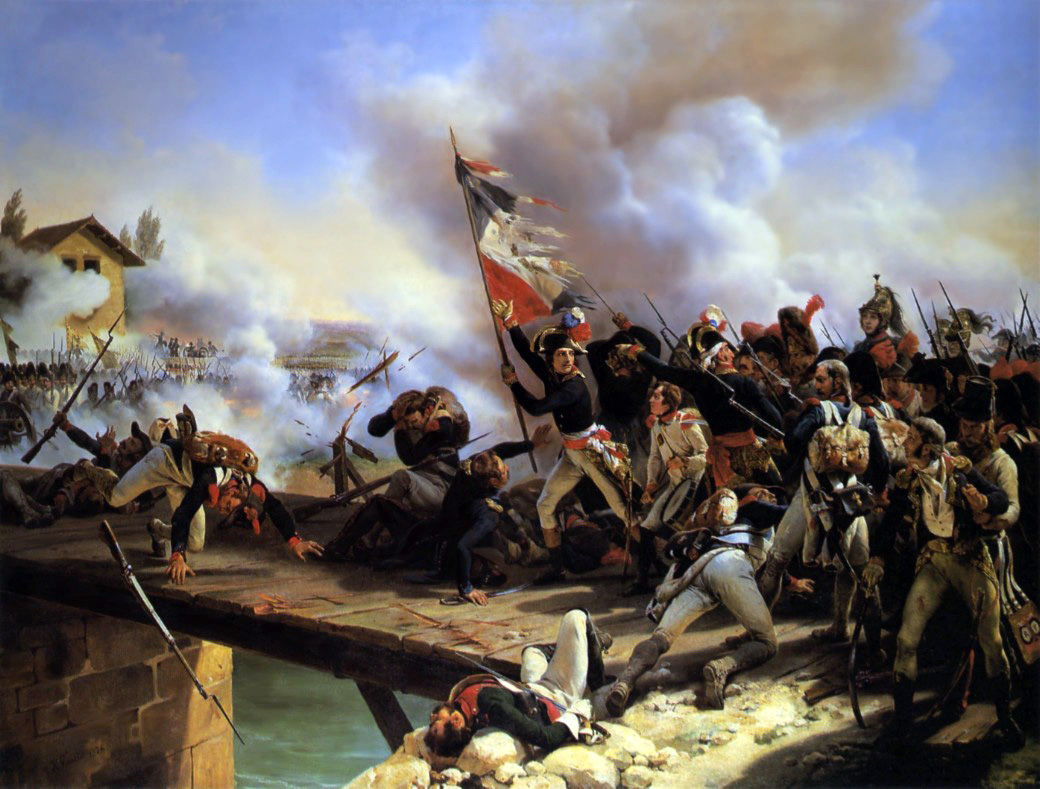
A major battle in the Italian campaign where Napoleon’s forces secured a critical victory against the Austrians.
The Vendean Revolt

While war raged across Europe, not all French people wanted a Republic (particularly one hostile to the Monarchy or the Catholic Church). The War in the Vendée was a counter-revolutionary insurrection and civil-war that took place in the Vendee region of France from 1793 to 1796. It provides a distinctly different context to wargaming the French Revolutionary Wars, with a specific range of figures produced by Perry’s, among others.
2. War of the Second Coalition (1798–1802)

Second Battle of Zurich: General Massena’s victory over the Russians (25-26 September 1799)
A new coalition formed, including Britain, Austria, Russia, Naples, the Ottoman Empire, and Portugal. Napoleon’s Egyptian campaign aimed to strike at British interests in India but ended in failure, with his fleet destroyed at the Battle of the Nile in 1798. Napoleon returned to France and seized power in a coup in 1799, becoming First Consul. Russian victories in Italy under General Suvorov threatened French power there. However, French victories in Switzerland and Italy, notably at Zurich, Marengo and Hohenlinden eventually dismantled the Second Coalition. Austria was forced to sign the Treaty of Lunéville in 1801, ceding the territory west of the Rhine to France and recognizing the French client states. Britain, facing isolation, signed the Treaty of Amiens with Napoleon’s government in 1802, bringing a temporary end to the Revolutionary Wars.
Battle of the Pyramids (21 July 1798)
.jpg)
A spectacular victory in Egypt that allowed for the conquest of the country, although the subsequent naval Battle of the Nile would undo these gains.
Battle of Marengo (14 June 1800)
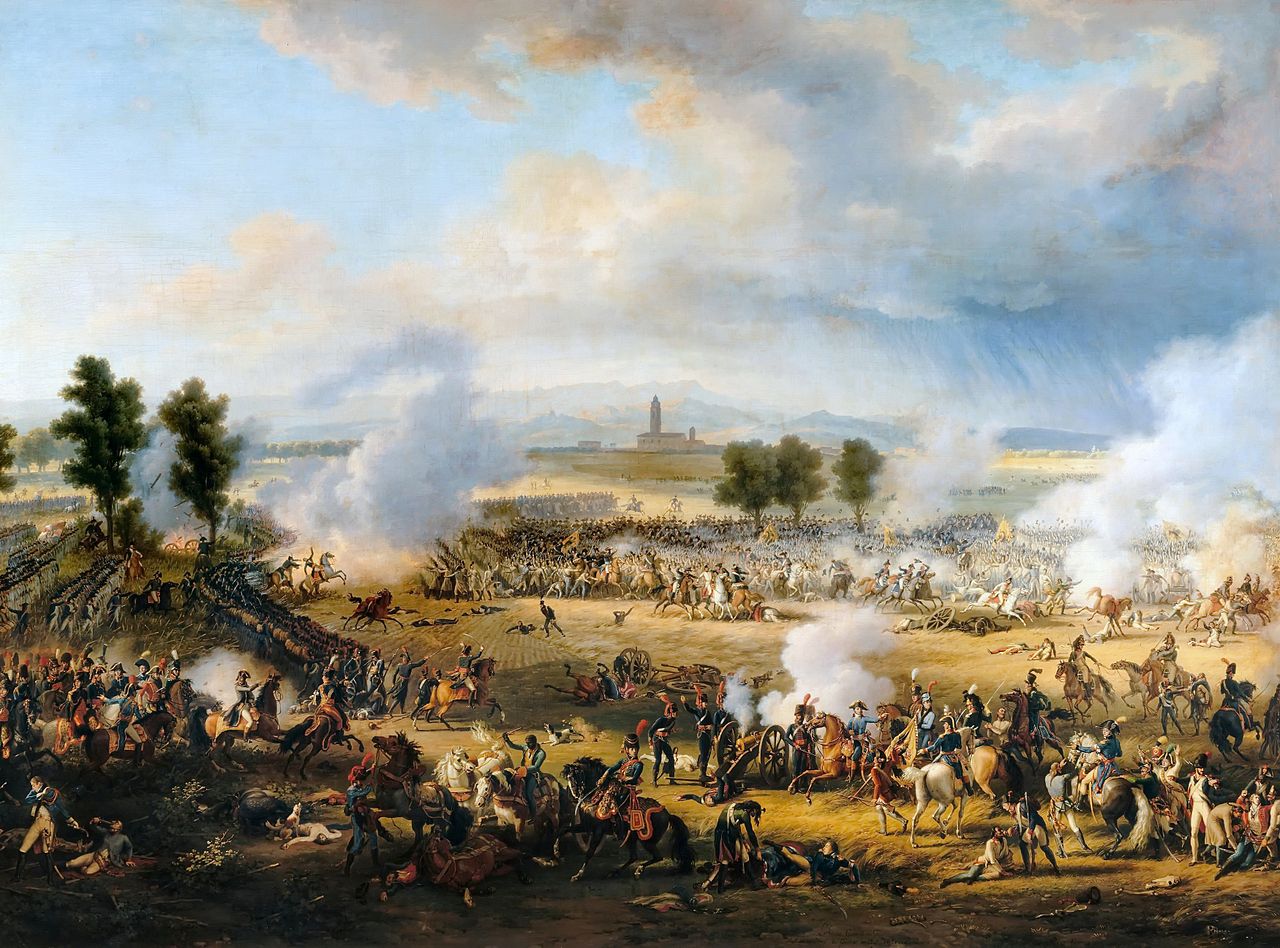
A hard-fought victory for Napoleon, solidifying his position as First Consul and leading to the defeat of the Austrians.
Battle of Hohenlinden (3 December 1800)

General Jean Victor Moreau won the battle of Hohenlinden against Austria in 1800, helping to finally end the Second Coalition.
II. ARMIES
MY FRENCH REVOLUTIONARY WARS ARMY

My French army currently consists of 14 battalions of infantry, 4 battalions of Consular Guard, 15 skirmisher bases, 2 Heavy Cavalry units, 1 unit of Chasseurs a Cheval, and 1 unit of Hussars, as well as four guns and crews. I have used Irregular Miniatures 28mm Revolutionary Wars, and 30mm Early Napoleonic ranges throughout. They are good value, look great, and cover all the major troop types and uniforms.
CONSULAR GUARD

The infantry of the Consular Guard historically consisted of two battalions of Grenadiers a Pied and one of Chasseurs a Pied. I have an extra battalion of Grenadiers so I can use them to represent line grenadier companies.

The flags were unusual, and I followed patterns online as I hand-paint all my flags onto sticky labels.
INFANTRY

I wanted a mix of uniforms in my French army to reflect the variation in clothing worn between 1792 and 1802. I also decided to paint some Seven Years War figures I had as French (i.e. wearing tricornes not bicornes). The flags were also irregular, which was a nice challenge.

Accordingly, I have a purple-uniformed unit which fought in the Egyptian campaign…

Infantry in standard bicornes (first rank), and in Tarleton (second rank)…

Ex-Infantry of the French royal army in white…

And scruffy veterans with bread (or joints of meat?) stuck on their bayonets…

I also have Light Infantry fighting in close order, in dark blue tunics and trousers…

And Militia in brown wearing tricornes…
SKIRMISHERS

I have a mix of light company skirmishers from Line regiments (white trousers), and Chasseur company skirmishers from the Light Infantry regiments (see above)…
CAVALRY

Although the French army did not have much heavy cavalry in the earlier years of this period, I couldn’t resist painting up two Cuirassier regiments in hats (no cuirass)…

A regiment of Chasseurs a Cheval…

And a regiment of Hussars…
ARTILLERY

My French artillery consists of four batteries currently, with more to be painted
MY AUSTRIAN ARMY OF THE REVOLUTIONARY WARS

My Austrian army consists of 18 battalions of infantry (including Hungarian infantry, and Grenadiers), 8 Grenzer skirmisher bases, an oversize regiment of Cuirassiers, one unit of Dragoons, and one unit each of Hussars and Lancers, besides four guns and crews. All from Irregular Miniatures, as with the French.
INFANTRY

Austria was France’s main Continental opponent throughout this period which is why I am collecting Austrian forces first. Her infantry was good, but could be slow moving because ‘ancien regime’ in mentality. As with the French, I used some Seven Years’ War figures I had at home as well as period-specific ones. I wanted a mix of uniforms to counteract the fairly monotonous white clothes, and my figures reflect this desire, with a range of facing colours:

Austrian Line Infantry in peakless black leather kasket with front plate…

Austrian Grenadiers in bearskin caps with brass plates…

Hungarian Line infantry in anachronistic tricornes (oh what the hell!)…

Hungarian Grenadiers (first unit are paint-job conversions from SYW Grenadiers)…
SKIRMISHERS

I used Grenzers to represent the Austrian light infantry, which was always less numerous than the French
CAVALRY

Austrian cavalry was generally excellent… what do you expect when you take over a third of Poland?

My collection includes Austrian cuirassiers (no cuirass)…

Austrian Dragoons in peakless black leather kasket…

Hussars…

And Lancers…
ARTILLERY

My Austrian gunners wear the traditional brown uniforms
III. TACTICS

A whiff of grapeshot!
The French Revolutionary Wars saw significant shifts in military tactics, evolving from the linear formations favoured by monarchist armies to the more flexible and aggressive approaches that would characterize Napoleonic warfare.
Mixed Order

One battalion of regulars in line, supported by two columns of levy infantry, was used by the French to integrate a demi-brigade of mixed quality for an assault. The columns could face outwards to act as emergency squares, thus protecting the line from cavalry. Here are some other key tactical elements employed by the French during the Revolutionary Wars:
Skirmisher screens

French armies frequently utilized large formations of light infantry skirmishers (tirailleurs) deployed ahead of the main body.
These skirmishers fought in open order, using cover and quick movement to harass enemy lines with fire, disrupt their formations, and demoralize them. This created a ‘skirmish screen’ that provided protection for the main infantry columns advancing behind them. The ‘tirailleur en grandes bandes’ tactic involved deploying entire battalions as skirmishers, which, though effective, was somewhat counterintuitive given the inexperience of some new recruits.
Column attacks

Infantry formations often attacked in battalion columns, emphasizing shock action over sustained firepower. These columns, requiring less training to form than traditional lines, were used to break through enemy lines, especially after skirmishers had softened them up. While effective against wavering enemy units, these column attacks faced challenges, particularly against well-disciplined lines that could deliver devastating volleys at close range.
Combined arms tactics

The French sought to integrate infantry, cavalry, and artillery to create a more synergistic fighting force. Napoleon, for instance, organized his forces into smaller, self-sufficient corps, enhancing flexibility and maneuverability.
Artillery standardization and tactics

The Gribeauval system, introduced before the Revolutionary Wars, standardized French artillery, making guns lighter, more mobile, and featuring interchangeable parts. This system significantly increased artillery mobility and effectiveness, especially when employed in conjunction with infantry and cavalry. Artillery was used for preliminary bombardments and could be concentrated into ‘grand batteries’ to target specific enemy positions. French artillery often prioritized targeting enemy troop formations with round shot at longer ranges and canister shot at close range.
Faster march rates and living off the land

French armies adopted a quicker pace of march (120 paces per minute compared to the orthodox 70), allowing them to cover more ground and achieve greater mobility.
Divisional structures, coupled with the chaotic revolutionary supply system, led to a greater reliance on ‘living off the land’ (foraging), which, despite challenges, further enhanced French mobility by reducing the need for cumbersome supply trains.

These tactical innovations, combined with the revolutionary fervour and large numbers of conscripted soldiers (resulting from the levée en masse), transformed the French Revolutionary Army into a formidable fighting force, capable of defending France and expanding its territory.
III. FIGURES & RULES
For 28mm French Revolutionary Wars miniatures, popular manufacturers include Warlord Games, Perry Miniatures, Skytrex (Trent Miniatures), Wargames Foundry, and Eureka Miniatures. I used the 28mm and 30mm ranges of Irregular Miniatures however, for an old school feel. My bases are 3x8cm (infantry) and 6x8cm (cavalry and artillery), from Warbases.
My rules ‘First Consul’ are a slight adaptation of my Napoleonic rules ‘Coup de Grace’. Other popular rulesets for this period include: Black Powder, Glory is Fleeting, Republic to Empire, Throwing Thunderbolts, Sharp Practice, and Valour & Fortitude.
IV. FURTHER READING
The French Revolutionary Wars have generated far fewer historical works than the Napoleonic Wars and remain relatively ‘undiscovered’ territory. However, besides online material, these sources are valuable for wargamers:
Art of War and Tactics
Griffith, Paddy, The Art of War in Revolutionary France, 1789-1802 (1998)
Muir, Rory, Tactics and the Experience of Battle in the Age of Napoleon (2000)
Flags
Letrun, Ludovic, French Infantry Flags from 1786 to the End of the First Empire (2009)
General
Haythornthwaite, Philip J., The Napoleonic Source Book (1991)
History
Esdaile, Charles J., The Wars of the French Revolution, 1792-1801 (2019)
Harper, Rob, Fighting the French Revolution – The Great Vendee Rising of 1793 (2019)
Ross, Michael, Banners of the King: The War of the Vendee 1793 (1975)
Orders of Battle
Smith, Digby, The Greenhill Napoleonic Wars Data Book (1998)
Uniforms
Crowdy, Terry, and Courcelle, Patrice, French Revolutionary Infantry, 1789-1802 (2004)
Haythornthwaite, Philip, and Warner, Christopher, Uniforms of the French Revolutionary Wars (1789-1802) (1997)
Von Pivka, Otto, Armies of the Napoleonic Era (1979)


